
Stamping and Forming Technology
From Cut-to-Length to the Assembled Profile Unit
Precise cutting to length is the starting point of every aluminium processing job. We saw aluminium profiles to exact dimensions – low-burr and true to angle. We are also equipped for mitre cuts and special angles.
Our circular saws and band saws handle profiles up to a cross-sectional size of 300 x 300 mm. Thanks to optimised cutting parameters and high-quality carbide saw blades, we achieve surfaces that can be processed further without rework. For series production, we rely on automatic feed systems with length stops to ensure reproducible results at high output.
A typical challenge: customers need burr-free cuts on visible profiles for facade or exhibition stand construction. Through the right combination of feed rate, spindle speed and saw blade geometry, we prevent smearing and burr formation right in the cut – eliminating the need for time-consuming manual deburring.
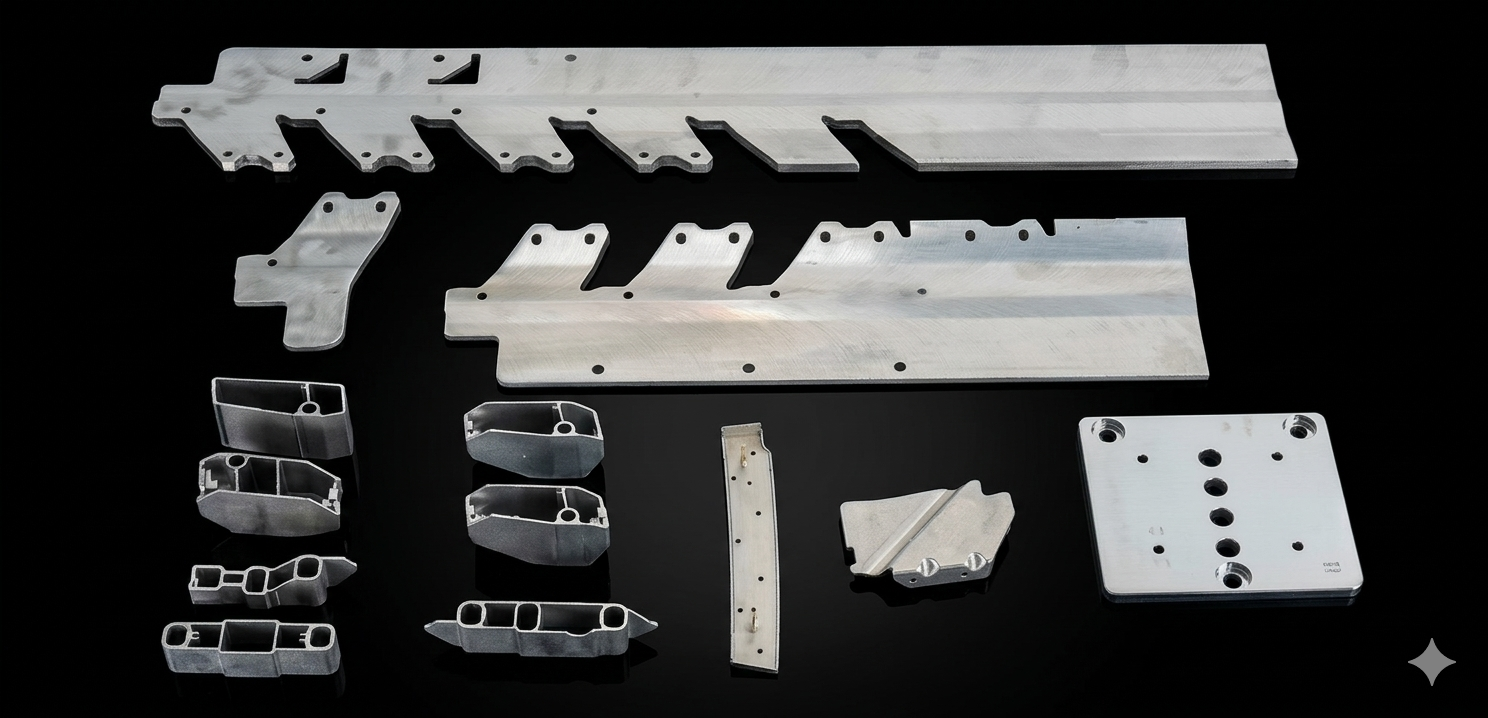
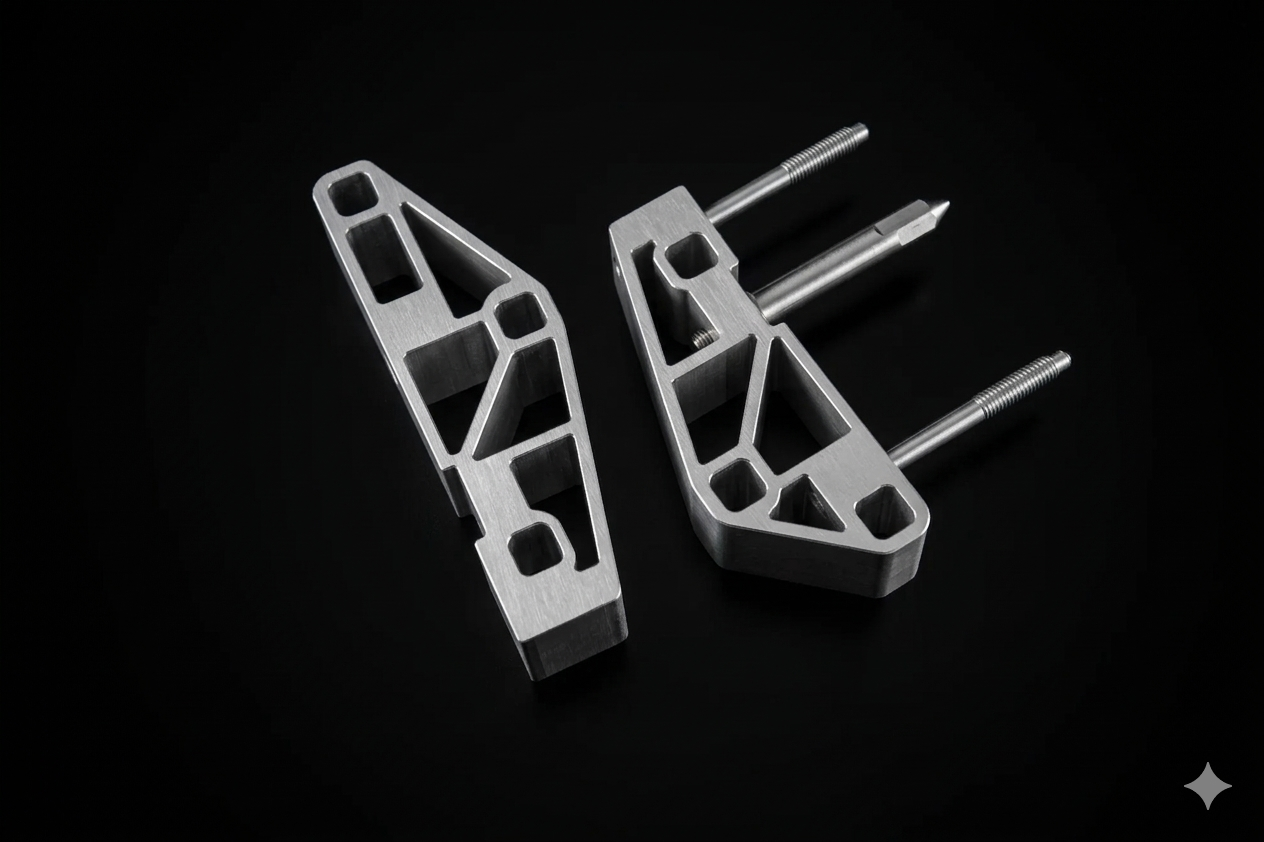
CNC profile machining from a single source: as your partner for aluminium profile machining, we handle every step on your aluminium profiles – from cutting profiles to exact length through CNC milling and drilling to deburring. CNC machining of aluminium profiles is carried out on our machining centres, for one-offs as well as series production.
For complex contours, pockets and fits, we use CNC milling machines. Holes and threads are produced in a single clamping operation – for the highest positional accuracy and economical manufacturing. We machine profiles up to 8 m long in a single clamping operation – with no re-clamping, hole patterns stay in alignment over the full profile length.
CNC machining of aluminium requires specific expertise: high cutting speeds, adapted rake angles and efficient chip removal are crucial for clean surfaces and tight tolerances. Our machining centres run at up to 18,000 rpm and achieve surface roughness values from Ra 0.8 to Ra 3.2 – depending on requirements.
Precision is especially important for construction profiles with slot systems (Item, Bosch Rexroth): hole patterns must match the grid dimensions exactly, and threads (M5, M6, M8) must sit precisely positioned and in alignment. Using multiple clamping, we machine up to 8 profiles simultaneously – significantly reducing unit costs in series production.
For high volumes, stamping holes and cutouts in profiles is the most economical method. On our eccentric presses (40–500 t), we stamp profiles quickly and precisely. Typical applications include hole patterns for fastening points, slotted cutouts for cable routing and openings for connectors. Tool-bound stamping eliminates expensive CNC run times – the tooling investment pays off from batch sizes of around 500 units. More on the materials page.
We bend aluminium profiles to your specifications. Whether a simple angle bend, Z-bend or complex 3D bend – our forming technology makes it possible. With aluminium, springback is a key factor: we compensate for this effect through adapted tool geometries, thereby guaranteeing dimensionally accurate bent parts. Embossing beads and stiffening ribs to increase profile rigidity is also part of our service portfolio.
On request, we assemble machined profiles into finished assemblies. Bolted, riveted or bonded – ready to install in your production. We join profiles with fittings, seals, plain bearings and electronic components into complete functional units. By having the assembly done at our facility, you reduce your internal logistics and receive an inspected, ready-to-install assembly delivered free to your door.
Aluminium processing is not your core business? We take over complete relocations involving several hundred tools. From tool transfer and sampling through process optimisation to a stable series start, we accompany the entire transfer. Reference customers from the automotive and electrical engineering industries rely on our experience in the seamless takeover of existing production operations.
Clean Edges and Ready-to-Process Surfaces
After sawing, milling and stamping, burrs and sharp edges inevitably occur on aluminium profiles. These can cause injuries during subsequent assembly and impair the appearance of visible components. That is why deburring is an integral part of our process chain.
Depending on the requirement, we use different deburring methods: manual deburring with scrapers for single parts and prototypes, mechanical vibratory grinding (tumbling) for series parts, and defined chamfering directly in the CNC machine. For anodisable visible parts, we pay particular attention to uniform edge radii, as these become visually prominent after anodising.
In addition, we prepare surfaces for subsequent treatments: cleaning of cooling lubricants, degreasing and, where required, grinding or brushing the surface. This ensures that anodisers and coaters achieve flawless results.
Aluminium Profiles in Industrial Practice
Aluminium profiles have a wide range of applications in vehicle construction: structural components for car bodies, battery frames for electric vehicles, heat sink profiles for power electronics and trim strips for the interior. We machine profiles for Tier-1 and Tier-2 suppliers with series approval to PPAP and deliver in batches of 1,000 to 500,000 units per year.
Housing profiles for control systems, DIN-rail enclosures, LED heat sinks and cable duct profiles – the electronics industry relies on aluminium for its excellent heat dissipation and EMC shielding. We manufacture profiles with tight tolerances for precisely fitting electronic installations and machine surfaces in preparation for anodising or powder coating.
Facade profiles, window frame systems, sun-shading louvres and railing structures made of aluminium combine low weight with weather resistance. We machine facade profiles with mitre cuts, slotted holes and threaded holes – ready for installation on the construction site. Special profiles for architectural projects with custom cross-sections are also part of our programme.
Machine frames made of construction profiles, linear guide carriers, protective enclosures and handling systems – mechanical engineering uses aluminium for lightweight and rigid constructions. We cut, drill and mill construction profiles from all common system suppliers and, on request, deliver fully assembled frame structures with connecting elements and end caps.
Technical and Economic Arguments for the Lightweight Material
As a material for profiles, aluminium offers a unique combination of low weight (density 2.7 g/cm³ – about one third that of steel), high corrosion resistance and very good machinability. Extruded profiles can be produced in almost any cross-sectional shape, allowing design freedom together with economical manufacturing.
In machining, aluminium scores with high achievable cutting speeds (up to 3,000 m/min) and low tool wear. This means short machining times and low unit costs. In stamping, the lower strength compared to steel allows the use of smaller presses and significantly reduces tool wear.
Another advantage is its complete recyclability: aluminium can be melted down and reused without loss of quality. This makes the material sustainable and lowers material costs in the long term, as aluminium scrap has a high return value.
Our Process for Your Aluminium Processing
You send us your drawing (PDF, DXF, STEP) or your 3D model by email. We check feasibility, analyse critical dimensions and tolerances, propose the most economical manufacturing method and prepare a detailed quote – usually promptly. For complex projects, we offer a personal consultation or an on-site visit.
Our work preparation team creates CNC programs, plans the tooling allocation and defines the optimal production sequence. For stamped parts, we coordinate tool procurement through our partner network. Before the series start, we produce initial samples for your approval. On request, we prepare an initial sample inspection report (ISIR) to VDA standard.
Machining is carried out according to documented inspection plans with in-process controls. We store your tools and fixtures and, on request, maintain safety stocks. After final inspection, we pack your parts securely for transport and deliver by freight forwarder or parcel service – on request also as a Kanban call-off directly to your production line.
As a rule of thumb: from around 500 units per year, a simple stamping tool pays off compared to CNC machining. With complex hole patterns or multiple machining steps, a progressive die can already amortise from 2,000 units. We are happy to advise you based on your specific quantities.
Yes, we also machine pre-anodised profiles. Please note that at the machined areas the anodised layer is broken through and the bare aluminium is exposed. For visible parts, we therefore recommend machining before anodising. For functional holes and threads in non-visible areas, machining after anodising is no problem.
Send us your profile drawings – we are happy to advise you.