
Evotec GmbH
Stamping and Forming Technology
A company of Evotec GmbH — DIN EN ISO 9001:2015
01

Extruded Profiles

Standard extruded profiles are the most economical choice for many applications. Round, square, U-, T-, L- and hollow profiles are available in numerous dimensions. We machine all common cross-sections up to a maximum circumscribed dimension of approximately 300 mm.

Typical wall thicknesses range from 1.0 to 15 mm. Extruded profiles are supplied in the T5 or T6 (age-hardened) condition, offering good strength values together with low weight. Extrusion also allows complex cross-sections with hollow chambers, webs and undercuts to be produced economically in large series.

02

Construction Profiles

Construction profiles with slot systems (e.g. Item, Bosch Rexroth, MiniTec) are the basis for machine frames, workstations and safety fencing. We saw, drill and mill these profiles to your specifications – precisely matched to the respective system grid (slot 5, slot 6, slot 8, slot 10).

Machining includes cutting to length, setting threaded holes (M5 to M12) at defined positions and milling openings for cable routing and access panels. On request, we deliver fully assembled frame constructions with brackets, end caps and slot nuts.

03

Special Profiles

We also machine custom special profiles from extrusion. No matter how complex the cross-section – our CNC machines and stamping presses handle any geometry. Special profiles are typically used as heat sinks, housing profiles, light strips or guide rails.

Close coordination between the profile manufacturer and the machining partner is crucial for special profiles: we advise you as early as the design phase on which machining steps on the profile are economically feasible, and we coordinate tolerances and reference surfaces with your extrusion supplier.
Profile Dimensions and Tolerances

What to Consider When Planning Aluminium Profiles

Extruded profiles are manufactured in accordance with DIN EN 755 and DIN EN 12020. The achievable tolerances depend on the profile cross-section, the wall thickness and the alloy. For standard extruded profiles made of EN AW-6060, tolerances to DIN EN 12020-2 (class "normal" or "precision") typically apply.

Important parameters in profile planning are the circumscribed diameter (which determines the press size), the minimum wall thickness (depending on alloy and profile shape, typically from 1.0 mm for EN AW-6060), as well as the straightness and twist over the profile length. Profiles with asymmetrical cross-sections are more prone to warping – this must be taken into account in the design.

Through our downstream CNC machining, we can tighten the extrusion tolerances where it is functionally necessary: we machine mating surfaces, hole spacings and mounting points to tolerances down to IT7 – significantly tighter than extrusion alone can deliver.

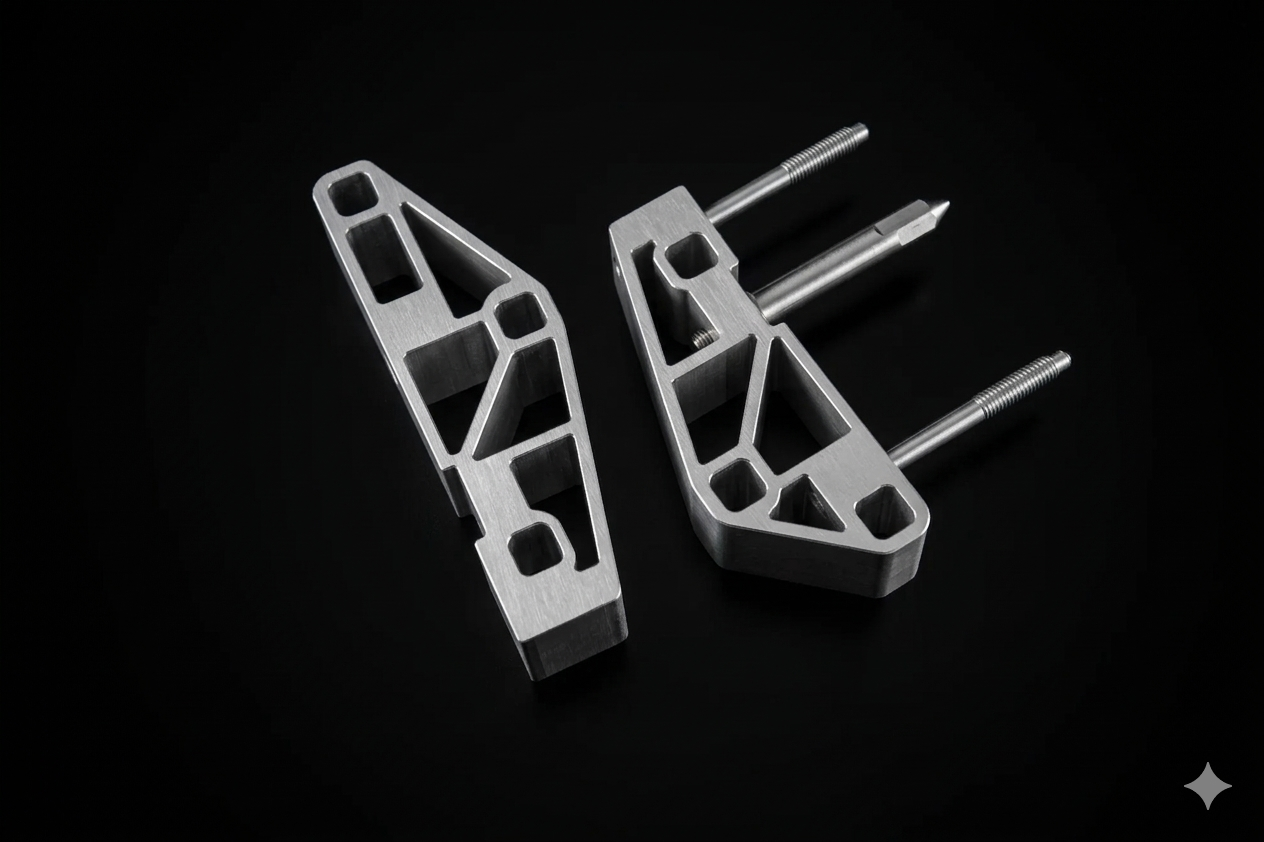
Precisely machined aluminium profiles

Aluminium Alloys for Profiles

The Right Alloy for Your Application

AlMgSi

EN AW-6060 / 6082

The standard alloy for extruded profiles. Age-hardenable, easy to anodise and with medium strength. EN AW-6060 (tensile strength approx. 190 MPa in the T6 condition) is suitable for thin-walled profiles with a decorative surface. EN AW-6082 (tensile strength approx. 310 MPa T6) is used where higher strength is required.

Processing note: Both alloys machine and stamp well. Chip formation is favourable, and built-up edges on tools rarely occur. When bending in the age-hardened condition (T6), a minimum bending radius of approx. 2x the material thickness must be observed. Applications: mechanical engineering, facades, structures, furniture.

AlMg3

EN AW-5754

Seawater-resistant and easy to form. For profiles in outdoor, vehicle construction and marine applications. Not age-hardenable, but with excellent corrosion resistance even without surface treatment. Tensile strength approx. 220 MPa (H22).

Processing note: EN AW-5754 tends to produce long chips when machined – adapted cutting parameters and chip breakers are recommended. In return, its formability is significantly better than that of the 6000-series alloys. Ideal for parts that are bent and then used in corrosive environments. More on the services page.

AlMg4.5

EN AW-5083

The high-strength alternative for structural components. The highest strength among the non-age-hardenable alloys, with a tensile strength of approx. 275–350 MPa depending on the condition. Typical for shipbuilding, rail vehicles and load-bearing structural parts.

Processing note: EN AW-5083 requires higher cutting forces in CNC milling than the softer alloys. Tool life is somewhat shorter. Higher press forces must be planned for in stamping. The alloy is weldable (MIG/TIG) and retains good strength values even in the heat-affected zone.

Al 99.5

EN AW-1050

Pure aluminium with the highest electrical and thermal conductivity (approx. 230 W/mK). Soft (tensile strength approx. 75–105 MPa), easy to form and corrosion-resistant. For heat exchangers, reflectors and electrical conductors in profile form.

Processing note: Due to its softness, EN AW-1050 tends to smear when machined. Sharp tools with a large rake angle and high cutting speeds are required. The material forms very well – bending radii close to the material thickness are achievable. Particularly suitable for reflector profiles that are subsequently high-gloss polished or anodised.

Material Procurement and Temper Designations

Useful to Know About Delivery Conditions and Procurement

Aluminium profiles are supplied in various heat-treatment conditions that have a significant influence on the mechanical properties. The most important temper designations according to DIN EN 515:

  • T4: Solution heat-treated and naturally aged – good formability, medium strength
  • T5: Cooled from the hot forming process and artificially aged – standard for extruded profiles
  • T6: Solution heat-treated and artificially aged – maximum strength, limited formability
  • H22/H24: Strain-hardened and partially annealed – typical for non-age-hardenable 5000-series alloys
  • O: Soft-annealed – maximum formability, lowest strength

Material procurement can be carried out through your own supplier (customer-supplied) or we handle procurement through our purchasing network. For regular call-offs, we set up framework agreements with profile dealers and keep standard dimensions in stock for short delivery times.

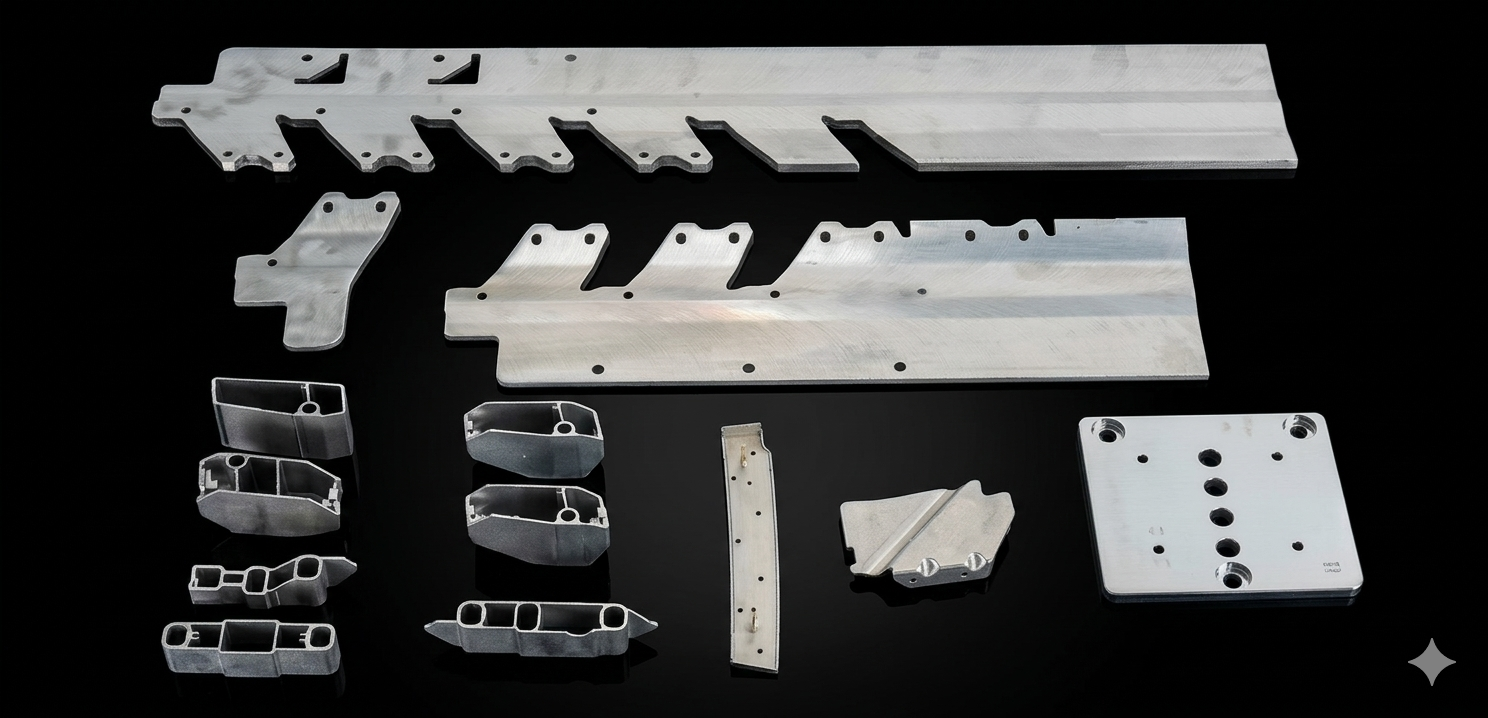
Aluminium profile material in various alloys

Material Selection: Which Alloy for Which Application?

A Decision Aid for the Right Aluminium Alloy

The choice of the right aluminium alloy depends on several factors: strength requirement, formability, corrosion resistance, surface treatment and cost. The following guide helps with the preliminary selection:

  • High strength required? EN AW-6082 (T6) or EN AW-5083 – for load-bearing structures and mechanically stressed parts
  • Decorative surface? EN AW-6060 – best anodising quality, uniform appearance, ideal for visible parts
  • Corrosion in outdoor environments? EN AW-5754 – seawater-resistant, durable even without surface protection
  • Electrical/thermal conduction? EN AW-1050 – highest conductivity, ideal for busbars and heat sinks
  • Maximum formability? EN AW-1050 or EN AW-5754 – for deep bends and complex forming operations
  • All-rounder? EN AW-6060 – the economical standard for 80% of all profile applications

Not sure which alloy is optimal for your application? We advise you based on your technical requirements and recommend the most economical solution. Simply send us your drawing or specification.

Different aluminium alloys in comparison

Surface Treatment After Machining

Finishing Through Our Partner Network

01

Anodising

Anodising creates a hard, corrosion-resistant oxide layer on the aluminium surface. Layer thicknesses of 5 to 25 micrometres are common. The surface can be dyed in various colours (natural, black, bronze, gold). Particularly suitable for EN AW-6060 and EN AW-6082, which form a uniform and decorative anodised layer.

02

Powder Coating

Powder coating offers maximum colour variety and high mechanical resistance. Layer thicknesses of 60 to 120 micrometres protect the aluminium even under extreme environmental conditions. All RAL colours as well as special colours and textured finishes are available. Suitable for all alloys.

03

Chromating and Passivating

Chromating and chromium-free passivation provide temporary corrosion protection and serve as a bonding agent for subsequent coatings. These treatments are particularly economical and are frequently used for components that are subsequently installed and not visible.

Aluminium Compared to Other Materials

When Is Aluminium the Right Choice?

vs.

Aluminium vs. Steel

Aluminium weighs only one third that of steel at comparable stiffness (relative to the profile, not the material). It does not corrode, requires no corrosion protection and can be machined at significantly higher cutting speeds. Steel is the better choice when absolute strength matters more than weight, or when material cost is the decisive factor.

vs.

Aluminium vs. Stainless Steel

Compared to stainless steel (V2A, V4A), aluminium scores with significantly lower weight, better machinability and lower material costs. Stainless steel is superior in high-temperature applications, chemical resistance to aggressive media and in hygienically critical applications in the food and medical technology sectors.

vs.

Aluminium vs. Plastic

Compared to engineering plastics, aluminium offers higher stiffness, better heat dissipation and EMC shielding. Plastic is lighter and cheaper for complex geometries in injection moulding. For profiles in mechanical engineering and electronics, aluminium is the better choice in most cases.

vs.

Aluminium vs. Copper

Copper has better electrical conductivity but is heavier and considerably more expensive. For busbars and conductor profiles, aluminium offers an excellent price-performance ratio: at the same resistance, an aluminium profile is lighter and cheaper than a copper profile, although it requires a larger cross-section.

Profile Consultation Required?

Not sure which profile and which alloy are optimal for your application? We are happy to advise you.